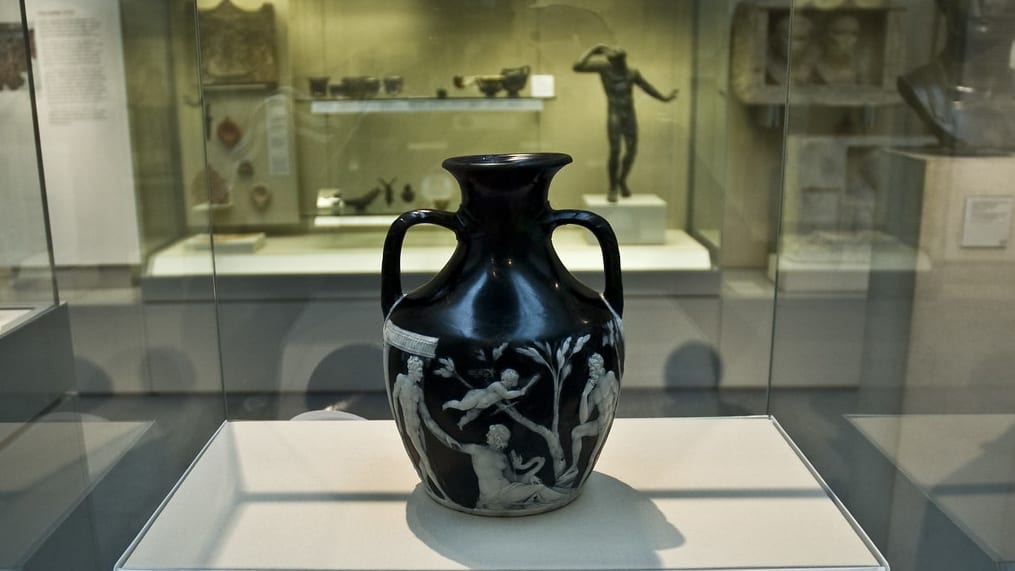
We have all been there. You go on a week-long drinking session, you find yourself in the British Museum and you end up drunkenly throwing a sculpture at the Portland Vase, smashing a priceless Roman artefact into pieces whose full restoration then ends up taking over 144 years.
The Portland Vase enjoyed a long and varied life before William Lloyd intervened after one too many ales on 7th February 1845. It has been dated to between AD 1 and AD 25 and is probably the most famous glass object in the world which has served as an inspiration to countless glass and porcelain makers over the centuries.
It is thought that the Portland Vase was discovered within a large marble sarcophagus belonging to the third century Roman Emperor Alexander Severus in a funerary monument a few miles southeast of Rome. The first recorded mention of the Vase was made in 1600 by the French antiquary Nicolas-Claude Fabri who saw it as part of a collection belonging to Cardinal del Monte.
Following Cardinal del Monte’s death in 1626, the Vase passed to the Barberini Family with whom it remained for 150 years. Maffeo Barberini – or Pope Urban VIII as he was better known – was particularly fond of the Vase. Being owned by the most powerful family in Rome meant that the Vase would grow to become one of Rome’s most famous artefacts over the next two centuries.
The Vase found its way to Britain in the 1770s when Donna Cordelia Barberini-Colonna suffered a bad run of luck gambling and was forced to sell off the Barberini Family heirlooms to pay her debts. A Scottish dealer called James Byres acquired it, selling it onto the British Ambassador to Naples, Sir William Hamilton. In 1784, Sir William sold it to the Duchess of Portland, but she had little time to enjoy her purchase as she passed away within 18 months.
The Portland Vase was put up for auction, but it stayed in the family, the Duchess’ son the Third Duke of Portland purchasing it. Shortly afterwards, the Duke lent the Vase to Josiah Wedgwood who spent four years trying to recreate the artefact in black and white jasperware pottery. Wedgwood eventually succeeded and it was his homages to the Portland Vase that led to a surge in interest in the artefact in Britain.
The Portland Vase was lent to the British Museum for display after Wedgwood completed his copies and when a friend of the Fourth Duke of Portland, by now the owner of the Vase, broke the base in 1810, it was transferred permanently to the Museum for safe keeping. Perhaps the Fourth Duke would have taken a different decision if he knew what was to happen 35 years later.
It was at 3.45pm on 7th February when Lloyd entered the Museum having been reportedly drinking for over a week – or in his words, “indulging in intemperance for a week before.” He picked up a large piece of basalt, part of a monument from the ruins of Persepolis and threw it at the glass case in which the Portland Vase was stored. The sculpture smashed the glass and the Vase itself. In seconds, Lloyd turned an artefact which had survived 1800 years into 189 pieces.
He was fined £3, equivalent to £367 in today’s money. Lloyd was unable to pay the fine and so spent two months in prison instead until an anonymous benefactor paid the fine to secure his release. It was later revealed that William Lloyd had been a fake name; the destroyer of the Vase was in fact a Trinity College student called William Mulcahy, who had been reported as missing in Ireland.
When Mulcahy’s true identity was revealed along with his troubled background and impoverished family, the Fourth Duke declined to instigate civil action against for the damage caused to the Vase, saying that he did not want to bring further problems to Mulcahy or his family. The Duke instead described the destruction of the Vase “an act of folly or madness which they could not control.”
Attention then turned to the restoration of the Portland Vase. The British Museum’s restorer John Doubleday was the first to make an attempt and his was relatively successful. Doubleday was however unable to replace 37 very small fragments. These pieces were sent by another of the Museum’s restorers to a box maker called Mr G.H. Gabb, who was asked to create a box with 37 different compartments, one for each fragment of the Vase.
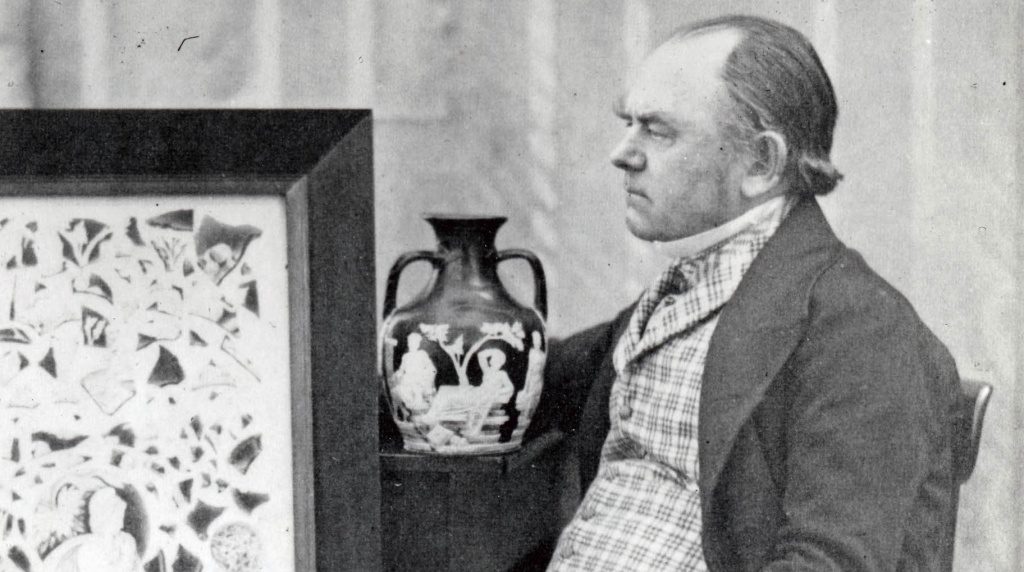
Before the box was completed, both Doubleday and his fellow restorer at the British Museum who commissioned the box passed away. Nobody came to collect the box and pieces and so they remained forgotten until 1948, when Mr Gabb himself died. The executor of his will, Miss Amy Reeves, brought in Mr. G.A. Croker to value Mr Gabb’s effects and it was Croker who found the box and sent it to the British Museum for identification.
The discovery of the missing pieces came at a good time. By 1948, the original restoration of the Portland Vase was beginning to look aged and so the decision was taken to dismantle the Vase and rebuild it again. Conservator J.W.R Axtell was responsible for the restoration job this time although he too struggled with the smaller pieces, managing to place only three of the 37 pieces into the rebuilt Vase which was completed in February 1949.
By the late 1980s, Axtell’s restoration was yellowing. The Vase had become so fragile that while other exhibits left the British Museum for the touring Glass of the Caesars exhibition, the Portland Vase had to stay behind. It was decided to undertake another restoration in the hope that adhesive technology had advanced enough in the 40 years since the last attempt to allow for a longer lasting repair.
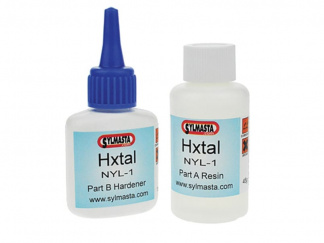
The key to that was finding the correct epoxy for the task. Before Nigel Williams and Sandra Smith carried out the third restoration of the Portland Vase, they tested a huge number of epoxy resins, eventually settling on Hxtal NYL-1 Clear Epoxy. Hxtal NYL-1 has exceptional non-yellowing qualities, even after significant periods of direct light exposure.
Discoloration had proven to be the major problem with the previous restoration attempts of the Portland Vase, but with Hxtal NYL-1 Epoxy that would not be an issue. The long-term transparent qualities of Hxtal NYL-1 Epoxy Resin combined with the super-strength bonding it provides mean that the Portland Vase isn’t expected to require any conservation or restoration work for at least another century.
The restoration of the Portland Vase became a major event. Press interest was huge and the BBC History and Archaeology Unit were on hand to film Williams and Smith as they embarked on the process.
They began by extensively photographing and drawing the Vase, recording the position of every fragment before wrapping it inside and out with blotting paper. It then sat in a glass desiccator which was injected with solvents for three days, breaking down the adhesive bonds of previous repairs and returning the Vase into the pieces that Mulcahy had shattered it into over 100 years earlier.
Each piece was individually cleaned by Williams and Smith, removing all traces of the previous adhesives used to in past restorations of the Portland Vase. It was then the job of Hxtal NYL-1 to join the pieces together. The curing process was aided by ultaviolent light, which can be used to offer greater control in glass repair. There are now even specially formulated glass adhesives which only bond when exposed to UV light.
There were some concerning moments during the restoration. Williams and Smith had decided to try and avoid reconstructing the Vase using any trap-outs, where the placing of one fragment prevents the next from fitting. This proved to be nigh-on impossible and with the Vase nearing completion at Christmas 1988, they broke up for the holidays fearing that they might have to deconstruct part of the Vase to fit the final few shards in, dismantling six months’ worth of work in the process.
Williams spent most of Christmas worrying about the situation, but when he and Smith returned to work in the New Year they were able to complete the top of the Vase perfectly. They even managed what their restoration predecessors had not and reintegrated the majority of the 37 lost pieces. Any gaps were filled with blue or white resins.
The restoration of the Portland Vase took nine months and at the end of the project, Williams gave his verdict: “”It’s OK… but it ruined my Christmas.” A worthwhile sacrifice to preserve a beautiful artefact with a fascinating history for another 100 years.
You may like…
-
 Hxtal NYL-1 Clear Epoxy AdhesivePrice range: £42.06 through £463.28 inc. VAT